
Cartons do not fill the width
The container is 235 cm wide inside. Three rows of cartons across their 60 cm side and one row across its 40 cm side take 220 cm. The last 15 cm stays empty on every layer.
See how many cartons or pallets fit in a 20 ft, 40 ft or high cube container. Enter the size, weight and quantity of your cargo, check the load in 3D and download the plan as a PDF or Excel file. Free to use, and calculated in your browser.
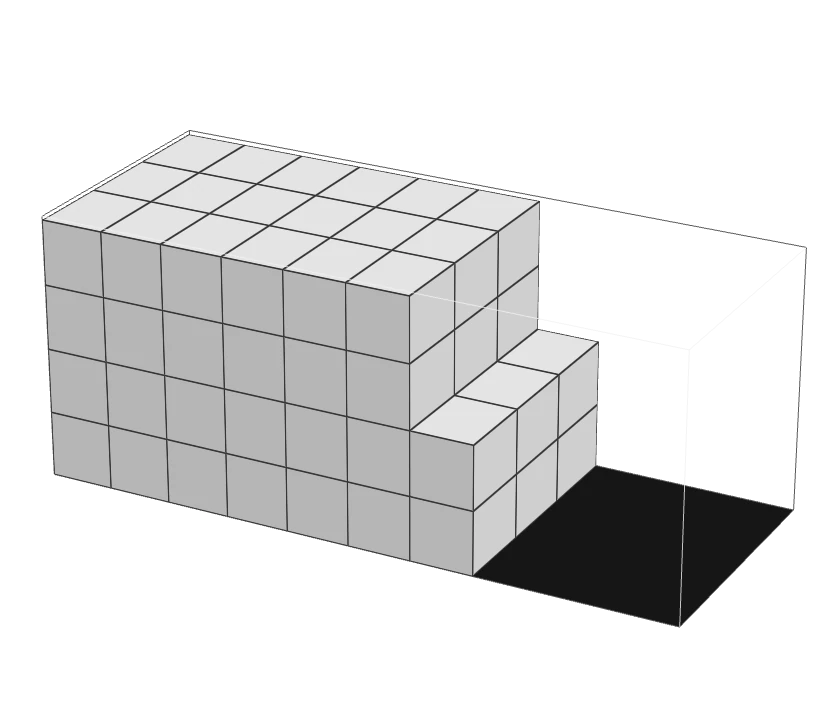
Container 2 is only part full. Ship 770 cartons to use one container, or add 340 more to fill both.
Container 1 is full by space. 35% of its payload is used.
Everything happens on this page. Nothing to install.
Pick a 20 ft, 40 ft, 40 ft high cube or 45 ft high cube container, or type the inside dimensions and payload of your own.
Enter the length, width, height, weight and quantity of each carton. Add every product you ship, load cartons on pallets, or import the list from Excel.
Turn the load in 3D and see how full each container is by space and by weight. Download the load plan for your warehouse or freight forwarder.
Inside dimensions of the four common dry containers, and how many 60 × 40 × 35 cm cartons this calculator fits in each.
| Picture | Container | Inside length × width × height | Door opening | Payload | Cartons of 60 × 40 × 35 cm |
|---|---|---|---|---|---|
| 20 ft33.1 m³ | Inside 5.90 × 2.35 × 2.39 m | Door opening 2.34 × 2.28 m | Payload 28,110 kg | 31853 per layer × 6 layers | |
| 40 ft67.4 m³ | Inside 12.02 × 2.35 × 2.39 m | Door opening 2.34 × 2.28 m | Payload 26,480 kg | 660110 per layer × 6 layers | |
| 40 ft high cube76.1 m³ | Inside 12.03 × 2.35 × 2.69 m | Door opening 2.34 × 2.59 m | Payload 26,280 kg | 770110 per layer × 7 layers | |
| 45 ft high cube85.8 m³ | Inside 13.54 × 2.35 × 2.70 m | Door opening 2.34 × 2.59 m | Payload 25,610 kg | 854122 per layer × 7 layers |
Typical dry containers. Inside dimensions, door openings and payloads vary by carrier and by container. Carton counts assume cartons kept upright, stacked to the roof with no gaps, at 12 kg each.
A 40 ft high cube container holds 76.1 m³ and the carton above is 0.084 m³, so dividing one by the other says 905 cartons. Placed one by one, 770 fit.
The container is 235 cm wide inside. Three rows of cartons across their 60 cm side and one row across its 40 cm side take 220 cm. The last 15 cm stays empty on every layer.
7 layers of 35 cm reach 245 cm. The container is 269 cm high inside, so the next layer does not fit and 24 cm stays empty.
A 20 ft container has room for 1,210 cartons of 40 × 30 × 20 cm. At 45 kg each, the payload is reached at 624.
The three common pallet sizes on the floor of a 20 ft and a 40 ft container, as this calculator places them.
| Pallet | 20 ft container | 40 ft container |
|---|---|---|
| Euro pallet120 × 80 cm | 11 palletsin a 20 ft container | 25 palletsin a 40 ft container |
| Standard pallet120 × 100 cm | 10 palletsin a 20 ft container | 22 palletsin a 40 ft container |
| US pallet48 × 40 in | 10 palletsin a 20 ft container | 21 palletsin a 40 ft container |
One level on the floor, with no gaps between pallets. Loaders usually leave a few centimeters, so a floor that takes 22 standard pallets on paper often takes one fewer. A 45 ft high cube takes 27 Euro pallets or 24 standard pallets. Pallets that can be stacked two high double the count.
The calculator answers two questions: how many fit, and how many containers you need.
Every carton sits inside the container, overlaps nothing, and rests fully on the floor or on the cartons below it. A container is closed when it runs out of room or reaches its payload, whichever comes first.
Weight distribution, axle loads, lashing and dunnage are not calculated. Heavy or fragile cargo still needs a stowage plan from your freight forwarder.
The plan is calculated in your browser. The cargo list you type or import is not uploaded.
Use the result for quotes and planning, and leave a few percent of slack. Real cartons bulge, pallets overhang, and the container you are given can be a little smaller inside than the typical sizes used here.
What to know before you book a container.
Yes. Calculating a load, viewing it in 3D and downloading the plan are free.
It depends on the carton. For a 60 × 40 × 35 cm carton this calculator fits 660 in a 40 ft container and 770 in a 40 ft high cube. Enter your own carton to get your number.
In one level with no gaps, a 20 ft container takes 11 Euro pallets (120 × 80 cm) or 10 standard pallets (120 × 100 cm). A 40 ft container takes 25 Euro pallets or 22 standard pallets.
A high cube is about 30 cm taller inside, 269 cm against 238.5 cm, with the same width and all but the same length. For most cartons that is room for one more layer.
CBM is volume in cubic meters: length × width × height in meters, times the number of cartons. The calculator shows the CBM of your cargo next to the result.
Yes. Add each product as its own cargo with a size, weight and quantity. The calculator loads them one after another and opens another container when the first is full.
Yes. Switch the units to inches and pounds at the top of the calculator. Container sizes change with them.