
905 by volume
770 placed one by one
The division says 905
A 40 ft high cube container holds 76.1 m³. A 60 × 40 × 35 cm carton is 0.084 m³, so the division gives 905 cartons. Only 770 fit.
Work out the volume of a shipment in cubic meters. Enter the size and quantity of each carton to get the total CBM, cubic feet and weight, see how much of a 20 ft or 40 ft container it fills, and check the chargeable weight for sea and air freight. Free to use, and calculated in your browser.
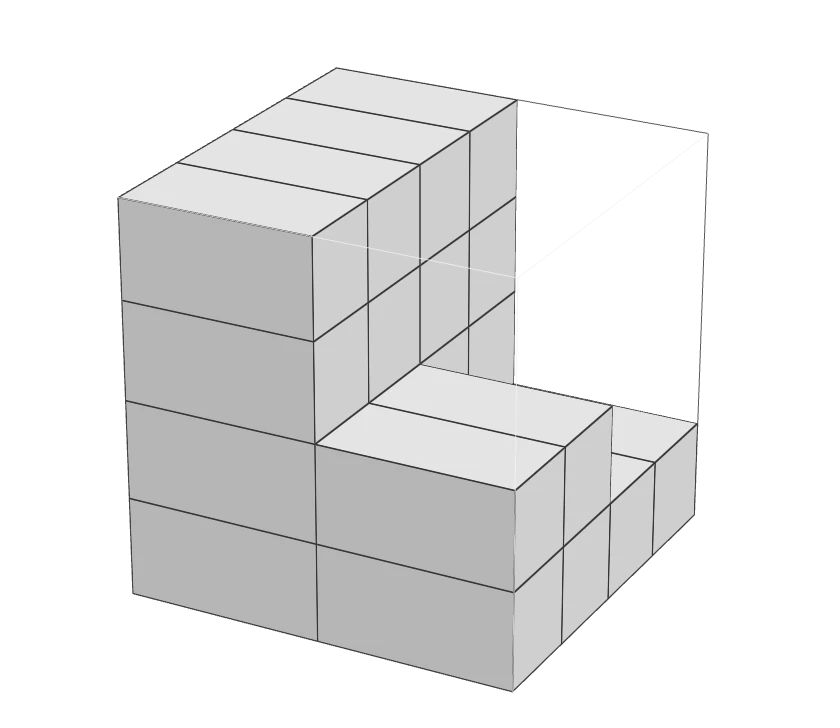
Placed carton by carton, everything fits one 20 ft container and takes 2.00 m of its 5.90 m length.
Volume alone says how full a container is on paper. Cartons leave gaps at the walls and under the roof, so fewer fit than the share suggests.
Everything happens on this page. Nothing to install.
Type the length, width and height of a carton and how many you are shipping. Add the weight if you want the chargeable weight too.
Add a row for each carton size, pallet or crate. Every row shows its own CBM, and the total updates as you type.
See the volume in cubic meters and cubic feet, the share of a 20 ft and a 40 ft container, and the weight sea and air carriers charge for.
CBM stands for cubic meter, the unit freight is quoted in. To convert, 1 m³ is 35.315 cubic feet.
with every side in meters. One carton of 60 × 40 × 35 cm is 0.60 × 0.40 × 0.35 m = 0.084 m³, and 100 of them are 8.4 m³.
| Unit | Formula | Example |
|---|---|---|
| Centimeters | length × width × height ÷ 1,000,000 | 60 × 40 × 35 ÷ 1,000,000 = 0.084 |
| Millimeters | length × width × height ÷ 1,000,000,000 | 600 × 400 × 350 ÷ 1,000,000,000 = 0.084 |
| Inches | length × width × height ÷ 61,024 | 23.6 × 15.7 × 13.8 ÷ 61,024 = 0.084 |
| Feet | length × width × height ÷ 35.315 | 1.97 × 1.31 × 1.15 ÷ 35.315 = 0.084 |
CBM is the right number for a freight quote. It is the wrong number for deciding whether an order fits in one container.
905 by volume
770 placed one by one
A 40 ft high cube container holds 76.1 m³. A 60 × 40 × 35 cm carton is 0.084 m³, so the division gives 905 cartons. Only 770 fit.
Cartons cannot be cut to fill the last 15 cm of the width, so that strip stays empty on every layer.
7 layers of 35 cm leave 24 cm under the roof, which is not enough for one more layer.
The volume inside the four common containers, and how much of it one ordinary carton size can really use.
| Container | Volume inside | 60 × 40 × 35 cm cartons that fit | CBM those cartons take | Payload |
|---|---|---|---|---|
| 20 ft | Volume inside 33.1 m³ (1,169 ft³) | Cartons that fit 318 | CBM they take 26.7 m³, 81% of the volume | Payload 28,110 kg |
| 40 ft | Volume inside 67.4 m³ (2,380 ft³) | Cartons that fit 660 | CBM they take 55.4 m³, 82% of the volume | Payload 26,480 kg |
| 40 ft high cube | Volume inside 76.1 m³ (2,686 ft³) | Cartons that fit 770 | CBM they take 64.7 m³, 85% of the volume | Payload 26,280 kg |
| 45 ft high cube | Volume inside 85.8 m³ (3,031 ft³) | Cartons that fit 854 | CBM they take 71.7 m³, 84% of the volume | Payload 25,610 kg |
Typical dry containers. Volumes and payloads vary by carrier and by container. Carton counts assume cartons kept upright and stacked to the roof with no gaps.
There is no fixed weight for one cubic meter of cargo. Carriers convert volume to weight with their own rule and charge whichever is greater.
Less-than-container sea freight is charged per m³ or per 1,000 kg, whichever is greater. A shipment lighter than 1,000 kg per m³ pays by volume.
Airlines charge the greater of the real weight and the volume weight: length × width × height in cm ÷ 6,000. That is 167 kg for every m³.
Express couriers usually divide by 5,000, which is 200 kg for every m³. Check the divisor on your carrier's rate sheet.
The calculator shows the sea and air figures next to the total. It does not quote freight: rates, minimum charges and surcharges come from your forwarder.
What to know before you ask for a freight quote.
Yes. Calculating and copying the result are free.
CBM is the volume of a shipment in cubic meters. Forwarders use it to quote sea freight and to judge how much of a container a shipment takes.
Multiply length × width × height in centimeters and divide by 1,000,000. Multiply by the number of cartons for the total.
Multiply length × width × height in inches and divide by 61,024. Or switch the calculator to inches and it converts for you.
A 20 ft container is about 33.1 m³ inside, a 40 ft about 67.4 m³ and a 40 ft high cube about 76.1 m³. Cartons never use all of it: one ordinary carton size fills between 81 and 85 percent.
It depends on the cargo. For charging, sea freight treats 1 m³ as 1,000 kg and air freight treats 1 m³ as 167 kg.
Multiply by 35.315. To go from cubic feet to CBM, divide by 35.315.